
Mobile Vascular Ultrasound for Faster Care
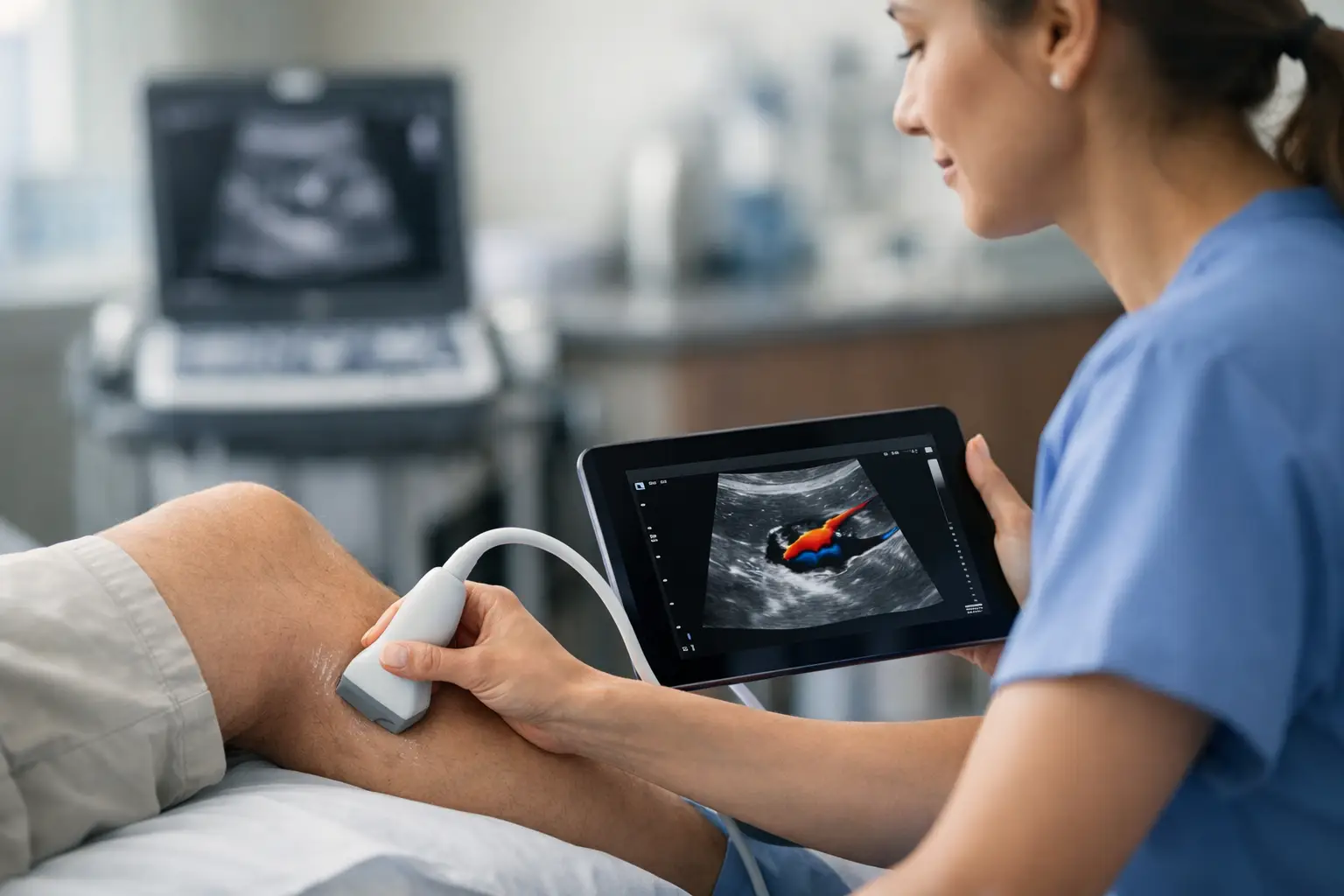
A patient with new leg swelling, exertional calf pain, or suspected carotid disease should not have to wait days for an outside imaging appointment before the care plan can move forward. Mobile vascular ultrasound brings the examination to the clinic, allowing providers to obtain essential diagnostic information without building and operating an in-house imaging department.
For clinic owners, medical directors, and practice administrators, the value is not simply convenience. A well-coordinated mobile service can reduce referral friction, preserve continuity of care, and give clinicians dependable access to credentialed sonographers and timely physician interpretation. The result is a diagnostic process that better fits the pace of outpatient medicine.
What Mobile Vascular Ultrasound Adds to Clinic Operations
Vascular ultrasound uses high-frequency sound waves and Doppler technology to evaluate blood flow in arteries and veins. It is noninvasive, does not use ionizing radiation, and can provide clinically useful information for a wide range of symptoms and surveillance needs.
The mobile model changes where and how that capability is delivered. Rather than purchasing equipment, maintaining it, staffing a department, and managing radiology workflow internally, a clinic schedules an on-site service. A qualified sonographer performs the ordered study at the facility, images are submitted for interpretation, and the provider receives a comprehensive report.
That structure is particularly useful when patients face transportation barriers, when a practice has recurring but not full-time imaging demand, or when outside referral centers create delays. It can also support facilities that want a more direct diagnostic pathway without taking on the fixed costs of a traditional ultrasound program.
Common vascular examinations
The right study depends on the clinical question. Mobile vascular services may support carotid duplex examinations for carotid artery assessment, venous duplex studies for suspected deep vein thrombosis or venous insufficiency, and arterial duplex studies for peripheral arterial disease, graft surveillance, or other flow-related concerns.
Aortic imaging may also be appropriate when screening or follow-up is indicated. The ordering provider should supply a clear indication, relevant symptoms, and pertinent history. That information helps the sonographer acquire targeted images and gives the interpreting radiologist the clinical context needed for a meaningful report.
Faster Access Does Not Mean Lower Standards
A mobile exam should be held to the same clinical expectations as an exam performed in a fixed imaging location. The convenience of on-site delivery only matters when image acquisition, interpretation, and reporting are properly coordinated.
Start with credentials. Vascular studies should be performed by sonographers with the appropriate qualifications for the examination, such as Registered Vascular Technologist (RVT) and Registered Diagnostic Medical Sonographer (RDMS) credentials where applicable. For cardiac-adjacent service lines, Registered Diagnostic Cardiac Sonographer (RDCS) credentials may also be relevant. Credentialed staff understand Doppler technique, required measurements, protocol adherence, and the documentation needed for reliable interpretation.
Equipment matters as well. A modern platform, such as the Mindray MX7 ultrasound system, supports high-quality imaging in a compact format suitable for facility-based service. Still, the system itself is only one part of quality. Probe selection, proper patient positioning, image optimization, complete protocols, and quality assurance all affect whether a study answers the ordering provider's question.
The final component is physician review. Board-certified radiologist interpretation provides an independent clinical read of the acquired images and findings. A report delivered within 24 hours gives the care team a defined timeframe for acting on results, contacting patients, and planning appropriate follow-up.
Where Mobile Vascular Ultrasound Fits Best
Mobile service is not a replacement for every imaging setting. A patient with acute limb ischemia, hemodynamic instability, severe symptoms requiring emergency evaluation, or concern for a time-critical vascular event may need immediate hospital-based assessment. Clinics should maintain clear escalation pathways for urgent findings and clinical deterioration.
For stable outpatient needs, however, on-site vascular imaging can be a practical fit. Primary care practices may use it to support evaluation of leg pain, edema, or vascular risk factors. Specialty clinics can use recurring service days to support established diagnostic pathways. Community health settings may use it to improve access for patients who would otherwise postpone or miss outside appointments.
The key question is not whether a clinic performs enough scans to justify buying a machine. It is whether patients and providers would benefit from reliable imaging access at the point of care. For many practices, demand is meaningful but variable. A flexible mobile model is designed for that middle ground.
Building a Dependable Workflow
A successful service arrangement should feel like an extension of the clinic's care team, not an extra administrative project. Before the first scheduled day, the clinic and imaging provider should agree on ordering requirements, patient preparation instructions, space needs, arrival procedures, and report delivery processes.
A standard exam room is often sufficient when it allows privacy, safe patient transfer, and adequate access to electrical power. The clinic should identify a point person who can coordinate the daily schedule, confirm orders, and help move patients through the visit. Small details, such as having prior studies available when relevant and verifying accurate patient demographics, prevent avoidable delays.
Scheduling deserves special attention. Some facilities benefit from a recurring service day, while others need periodic coverage based on referral volume. The right cadence depends on patient demand, the range of ordered examinations, provider availability to review results, and the clinic's goal for turnaround. A recurring schedule may improve predictability, while an on-demand plan may better serve lower-volume settings.
Providers also need a plan for results management. Reports should route to the appropriate clinician promptly, with a clear process for communicating routine findings, arranging follow-up imaging, and escalating urgent or unexpected findings. A 24-hour reporting standard is valuable because it creates accountability, but the clinic's internal follow-up process must be equally clear.
The Financial and Staffing Trade-Off
Owning ultrasound equipment can make sense for high-volume organizations with stable demand, dedicated sonographers, established medical oversight, and the resources to manage maintenance, quality control, credentialing, and scheduling. It is not automatically the best decision simply because a clinic orders vascular studies regularly.
The total cost of an internal program extends beyond the initial equipment purchase. Practices must account for service contracts, software and archive systems, probe replacement, staffing coverage, continuing education, protocol oversight, downtime, and the administrative work required to keep the program operating. Hiring and retaining certified vascular sonographers can be particularly challenging when staffing markets are tight.
A mobile arrangement converts much of that fixed operational burden into scheduled service capacity. This can make costs more predictable and reduce the risk that a clinic owns expensive equipment that sits unused for part of the week. The trade-off is that availability must be planned. Clinics should choose a provider that can offer a service schedule aligned with their expected volume and patient needs.
Questions to Ask Before Choosing a Provider
Healthcare leaders should evaluate a mobile imaging partner with the same care they would use when assessing any clinical service. Ask who performs the examinations, which credentials they hold, what equipment is used, and how the provider maintains protocol consistency. Confirm who interprets the studies, how reports are delivered, and the expected turnaround time.
It is also reasonable to ask about insurance coverage, facility requirements, privacy practices, documentation support, and communication procedures for significant findings. The objective is not to create unnecessary complexity. It is to ensure that the service fits the clinic's existing standards for patient safety, clinical communication, and operational accountability.
Washington Mobile Ultrasound coordinates credentialed field sonographers, modern portable imaging, board-certified radiologist review, and reports within 24 hours. For practices in Olympia and surrounding communities, that coordinated model can create a more practical path from patient presentation to diagnostic clarity.
A Better Diagnostic Path for Patients
When vascular imaging is available where patients already receive care, the process becomes easier to complete. Patients spend less time navigating a separate referral, traveling to an unfamiliar location, and trying to coordinate another appointment around work, caregiving, or limited transportation. Providers gain the ability to move from concern to diagnostic information with fewer handoffs.
The most useful mobile vascular ultrasound service is not defined by portability alone. It is defined by dependable scanning, qualified personnel, physician interpretation, clear reporting, and a workflow that respects the clinic's time. When those pieces are in place, on-site imaging can help teams make informed next-step decisions while keeping patient care closer to home.